
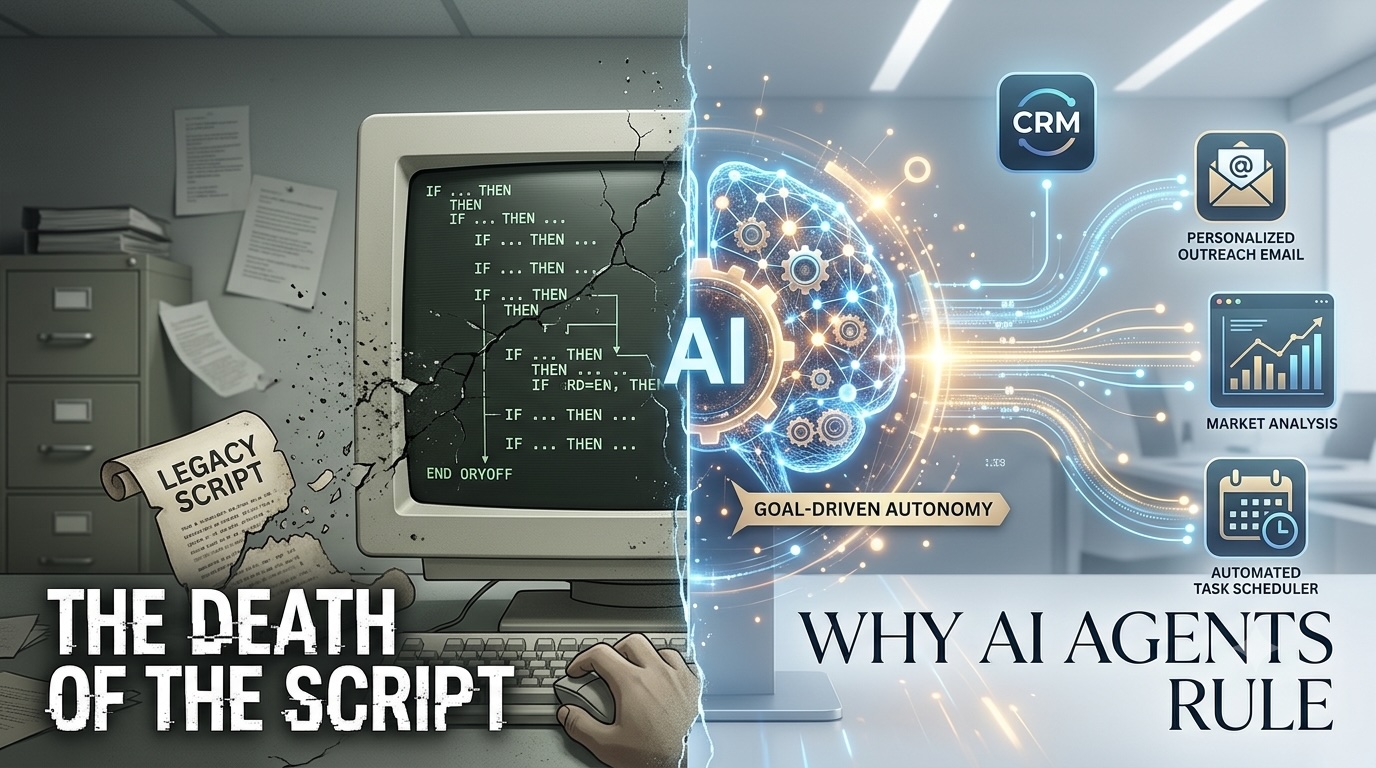
For most of the last decade, business "automation" has meant one thing: rigid, rule-based logic. If an order is marked 'shipped,' then trigger an email. If a form is filled out, then create a row in a spreadsheet. This paradigm, the cornerstone of platforms like Zapier and IFTTT, made us faster and reduced human error, but it hit an invisible ceiling. The moment a task requires reasoning, handling a slight deviation, or synthesizing unstructured data, the brittle logic breaks. A human has to step back in.
We are now on the precipice of the next major evolutionary step in productivity: autonomous AI agents. Unlike their predecessors, AI agents don't just execute a step; they achieve a goal.
The Brittle Era of Rule-Based Scripts
Traditional automation operates on deterministic paths. They are incredibly powerful for transactional tasks that follow a 100% predictable flowchart. But the real world, and most high-value business operations, are rarely that linear.
A logic-based script cannot answer a slightly ambiguous customer email ("I need help with that thing I bought"). It cannot judge if a competitive analysis document is comprehensive. It cannot intelligently retry a failed task in a different way. If the environment changes, the script breaks, often silently, and requires constant maintenance.
The fundamental limitation is that rules lack reasoning. This means they are inherently non-scalable when dealing with complexity.
The Autonomous Shift: Why Agents Are Different
AI agents, powered by Large Language Models (LLMs), operate in an entirely different universe. They introduce probabilistic reasoning and autonomy into the workflow.
When you give an AI agent a goal—e.g., "Find and qualify 20 new enterprise leads in the SaaS sector"—it doesn't follow a hard-coded flowchart. Instead, it engages in a powerful loop:
Reason: The agent breaks the complex goal into a series of logical sub-tasks.
Act (Use Tools): The agent independently selects and uses tools to accomplish each task. It might search the web, query a CRM, or generate an email.
Refine (Observe & Adapt): Critically, the agent analyzes the output of its last action. If a lead source looks weak, it learns and tries a different one. It adapts its strategy based on new information, just like a human would.
An agent doesn't need a specific rule for every contingency. If a customer emails "help with that thing," the agent understands the ambiguity, asks clarifying questions (context-gathering), accesses order history, and uses its general knowledge to diagnose the problem. The script is dead; the reasoning model is the new standard.
The Strategic and Economic Impact
The migration from scripts to agents is more than just a tech upgrade; it’s a redefinition of work itself.
From Linear to Parallel: Scripts run one action after another. Multiple, coordinated agents can run entire, complex workflows (like creating a complete marketing campaign from research to execution) concurrently.
From Low-Value to High-Value Work: By handling ambiguous but repetitive decisions, agents free teams to focus on strategy, empathy-driven complex problem solving, and genuine relationship building—tasks that still require a human touch.
True Scalability: An AI agent fleet can scale dynamically to handle demand, whether it's 10 customer inquiries or 10,000, without hiring costs or script-maintenance bottlenecks.
The future isn't defined by the sophistication of our automation scripts. It's defined by the autonomy of our AI workforce. The shift is already happening. Those still trying to write a rule for every problem will find themselves left behind by those who simply give their agents a goal.
No comments yet — be the first to share your thoughts.